Before the Clock
A connected system that teaches toddlers to understand time, before they can read a clock
Personal systems-design project • original concept from 2016
This reimagining was built in one day, in collaboration with AI across research, prototyping, and system diagramming
Project Overview
Long before a child can read a clock, they understand that "blue means lunch is coming." Developmental research backs this more precisely than expected: a toddler's early sense of time is tied to familiar events, not the clock - formal time understanding doesn't take hold until around age 5, and isn't mastered until 8.
Most "time-telling" products for kids skip straight to a simplified clock face. Almost nothing is designed for the years before that, when a child is building the association between a cue and an activity, and not yet the mechanics of hours and minutes.
I first explored this as a two-week concept sketch: a single toddler watch using color, then shape, then number. I came back to it with a different question ten years later — what would it take to build the actual scaffolding a child's brain needs before clock-reading, as a system a parent could run daily.
The system
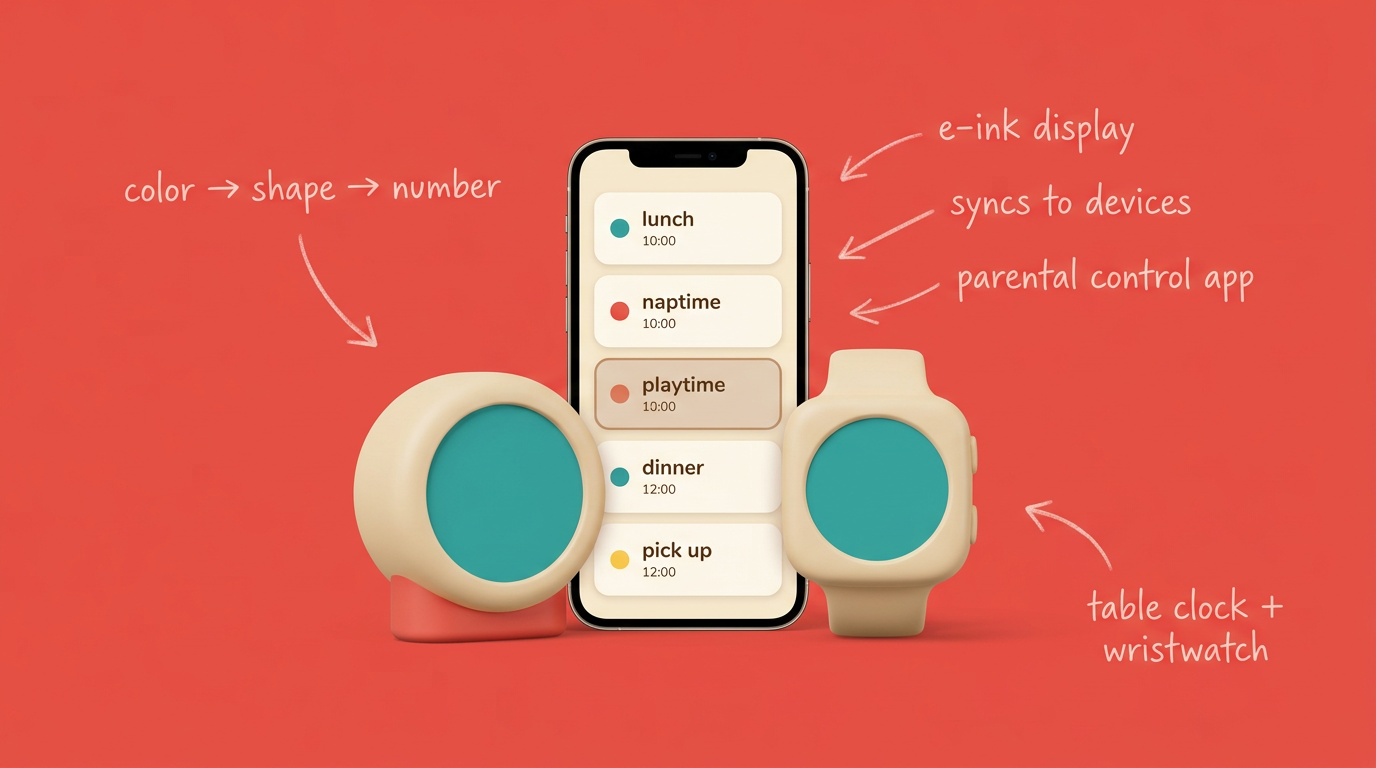
One wearable wasn't enough. A toddler needs the cue wherever they are; a parent needs to set it once and trust it; the system needs to grow with the child without becoming a curriculum to manage.
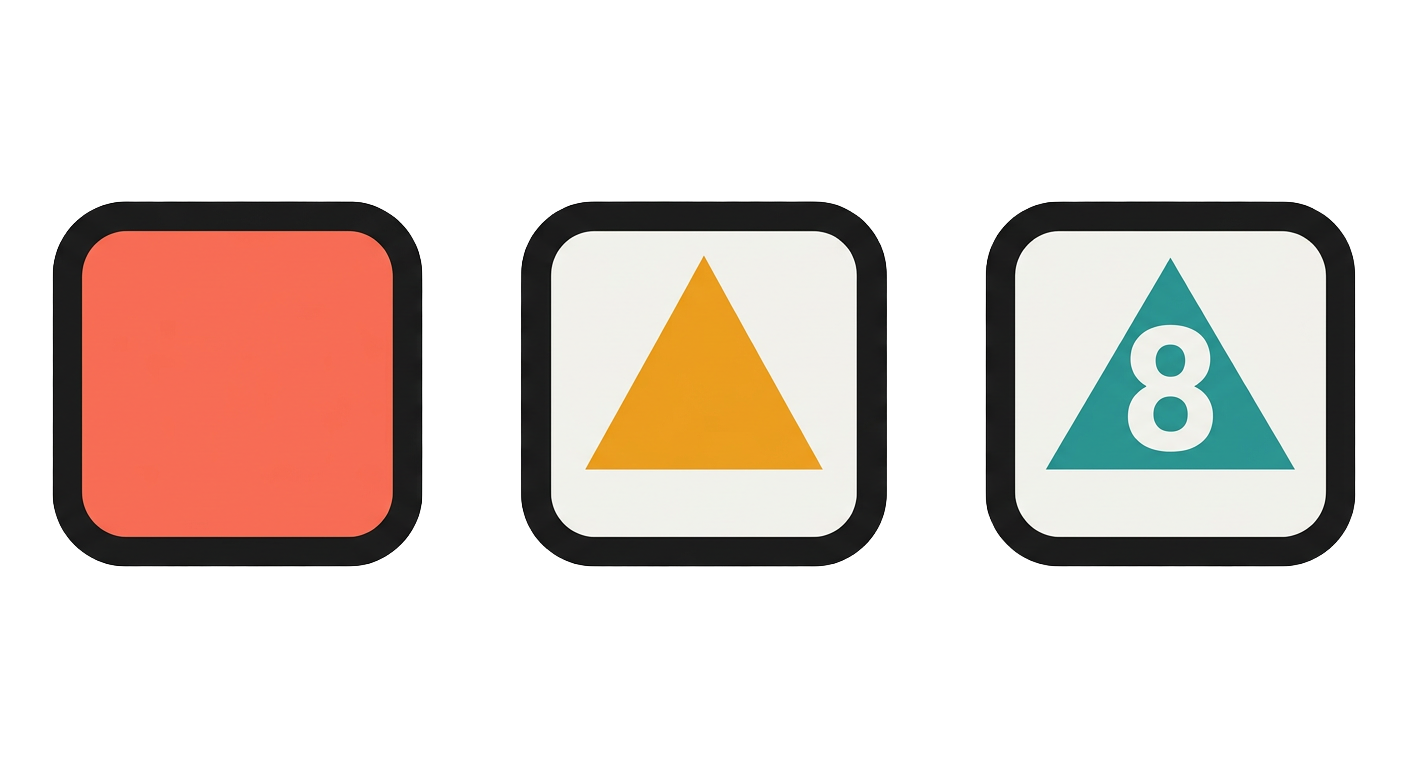
That reframing produced three connected parts: a table clock, a wristwatch, and a parent app that ties them together - each stage a bridge toward real clock-reading rather than a simplified version of it:
color-only at 18 months
color+shape by 24 months
shape+number by 30 months
I used Claude to synthesize developmental psychology literature on early time-concept formation and visual-schedule research, directing the research questions myself and weighing the findings against what the design actually needed. Two findings shaped the system directly: shape recognition has been linked to longer-term cognitive outcomes, which is why shape enters early rather than as an afterthought; and visual schedules work best when a cue visibly changes state once the task is done, which is why the devices display time and log responses.
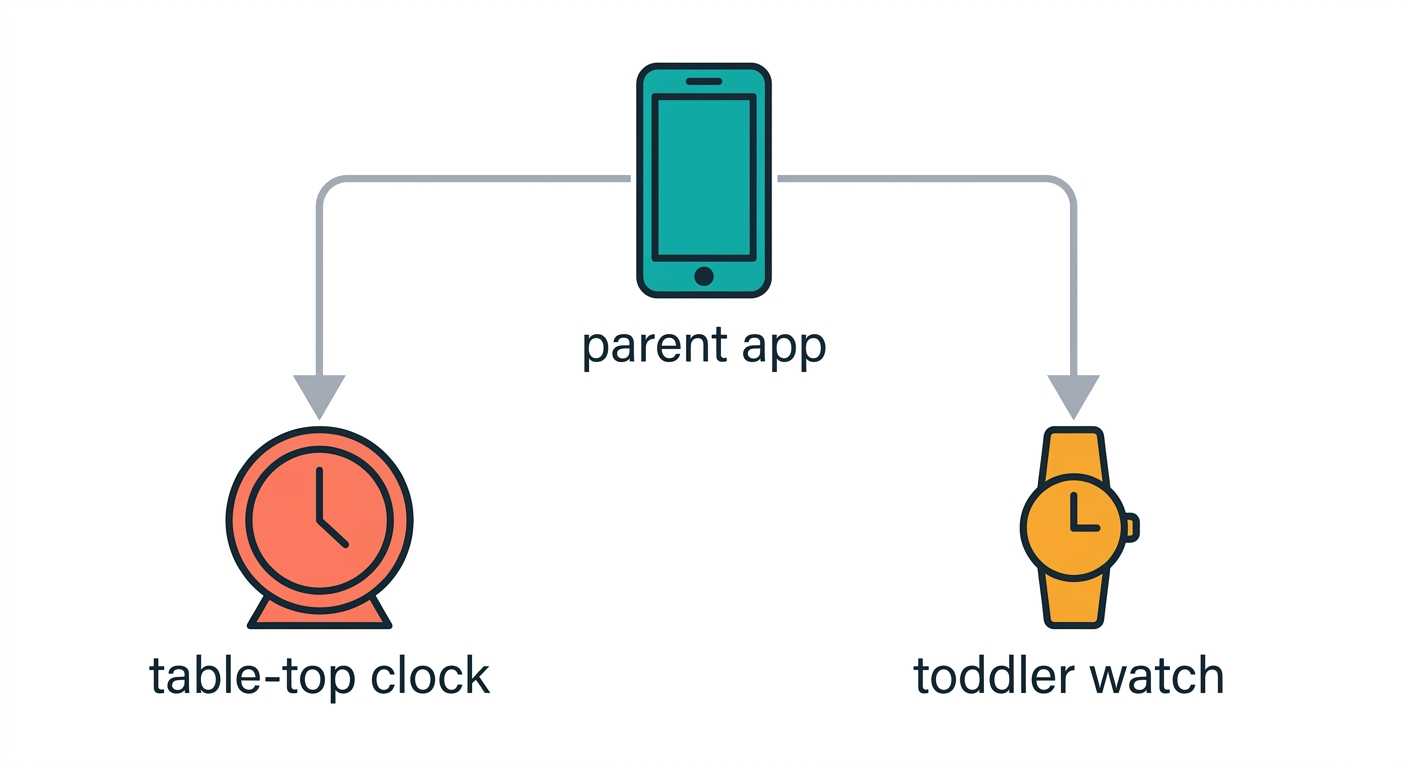
Feedback loop and device map
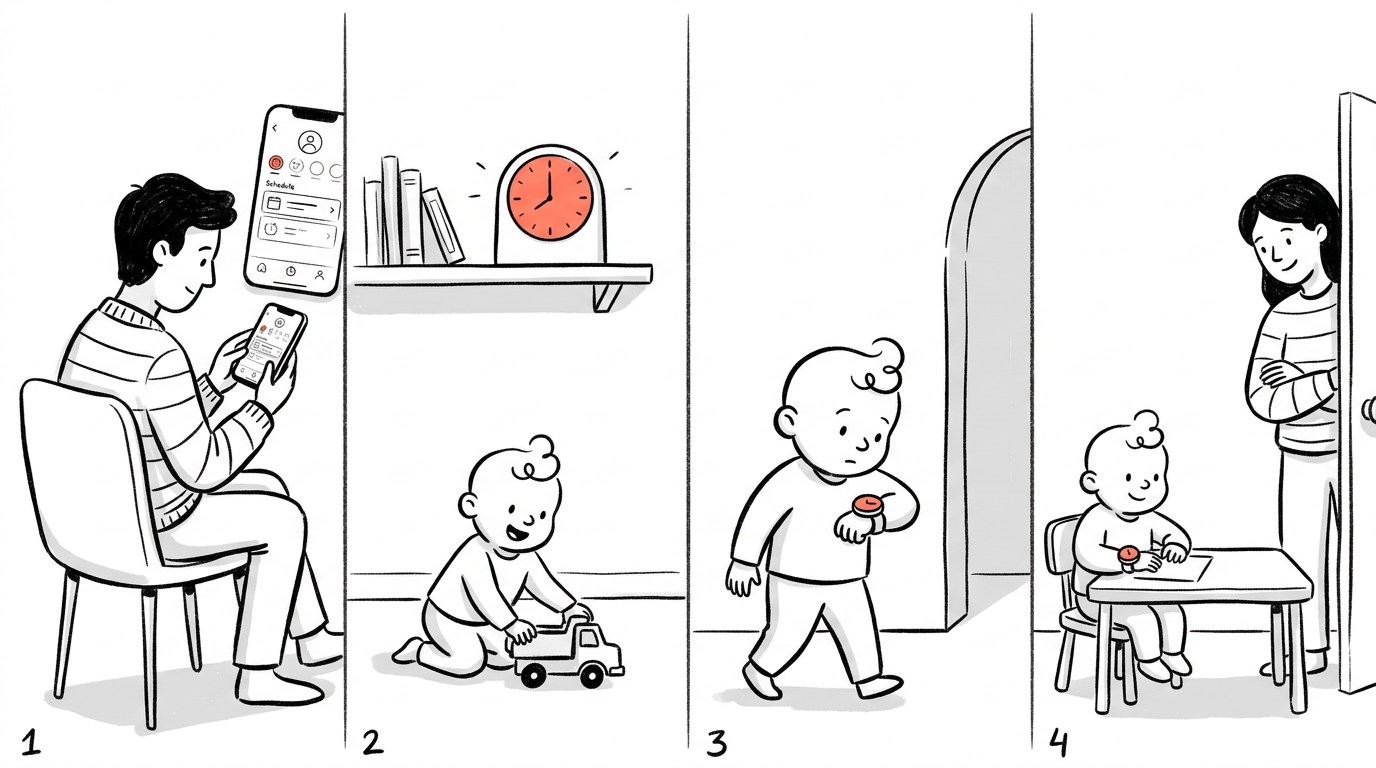
Every routine runs the same cycle:
parent assigns an activity to a time
devices display the cue
child observes and associates it
child responds independently
the app logs the response and adjusts the next stage's difficulty.
The table clock and wristwatch sync from the app and report back; neither has a screen the child operates.

Prototype
I wrote detailed prompts for Claude Code to build the parent app and the device-interface simulators, rather than working from static mockups alone. This let me test interaction decisions as working software. One example: my first pass at the e-ink device simulator rendered instant, smooth transitions.
What I’d test next
Whether stage progression should be strictly age-gated or responsive to observed behavior — the research shows real variation between children at the same age.
Whether parents want a "readiness" nudge, or whether that reads as one more thing being tracked about their kid.
Battery and durability for the physical devices, carrying forward the unbreakable-material thinking from the original 2016 sketch.
View the original project from 10 years ago that inspired this re-imagining.
Research resources
1. Formal time understanding develops late; early time sense is event-dependent
Friedman, W. J. (2008). Developmental Perspectives on the Psychology of Time. Advances in Child Development and Behavior. https://www.sciencedirect.com/science/chapter/bookseries/abs/pii/S0065240708600403 — Source for: conventional/clock time has little influence on children under 5; time measurement and calendar cycles aren't mastered until around age 8.
Hoerl, C., & McCormack, T. (2019). The Development of Temporal Concepts: Learning to Locate Events in Time. Timing & Time Perception, 5(3-4). https://brill.com/view/journals/time/5/3-4/article-p297_297.xml?language=en (Preprint also available: https://www.researchgate.net/publication/321767297_The_Development_of_Temporal_Concepts_Learning_to_Locate_Events_in_Time) — Source for: young children think about time in an event-dependent way before developing an event-independent, linear sense of past/present/future.
Levin, I. (1982). The Development of the Concept of Time in Children: An Integrative Model. In The Developmental Psychology of Time. https://link.springer.com/chapter/10.1007/978-94-017-3536-0_3 — Background source on the broader Piagetian and post-Piagetian research tradition on children's time-concept development
Qu, F., Shi, X., Zhang, A., & Gu, C. (2021). Development of Young Children's Time Perception: Effect of Age and Emotional Localization. Frontiers in Psychology. https://doi.org/10.3389/fpsyg.2021.688165https://www.ncbi.nlm.nih.gov/pmc/articles/PMC8217659/ — Source for: time sensitivity increases with age and approaches adult-like precision only around ages 8–10; most prior research undersamples children younger than 5.
2. Shape recognition matters early, and predicts long-term outcomes
Torkildsen, J. von Koss, et al. (2019). Brain Measures of Toddlers' Shape Recognition Predict Language and Cognitive Skills at 6–7 Years. Frontiers in Psychology. https://doi.org/10.3389/fpsyg.2019.01945https://pmc.ncbi.nlm.nih.gov/articles/PMC6716541/ (Also indexed at: https://www.frontiersin.org/journals/psychology/articles/10.3389/fpsyg.2019.01945/full) — This is the primary source for the case study's claim that shape recognition, measured at 20 months, predicts language and cognitive ability years later.
3. Visual schedules are an evidence-based practice, and work best combined and state-changing
Steinbrenner, J. R., Hume, K., Odom, S. L., Morin, K. L., Nowell, S. W., Tomaszewski, B., Szendrey, S., McIntyre, N. S., Yücesoy-Özkan, S., & Savage, M. N. (2020). Evidence-based practices for children, youth, and young adults with autism. The University of North Carolina at Chapel Hill, Frank Porter Graham Child Development Institute, National Clearinghouse on Autism Evidence and Practice Review Team. https://ncaep.fpg.unc.edu/wp-content/uploads/EBP-Report-2020.pdf — Source for: visual supports are a well-established evidence-based practice, originally validated in autism-intervention research.
Dees, R., Sam, A., Waters, V., & AFIRM for Toddlers Team. (2023). Visual Supports for Toddlers — EBP Brief Packet. The University of North Carolina at Chapel Hill, Frank Porter Graham Child Development Institute, Autism Focused Intervention Resources and Modules for Toddlers. https://afirm.fpg.unc.edu/wp-content/uploads/Visual-Supports-for-Toddlers-Brief-Packet-Dees-et-al-2023.pdf — Source for: visual supports/schedules as a defined evidence-based practice specifically for toddlers, including guidance that supports should match developmental concreteness (object → photo → icon → symbol).
Knight, V., Sartini, E., & Spriggs, A. D. (2014). Evaluating Visual Activity Schedules as Evidence-Based Practice for Individuals with Autism Spectrum Disorders. Journal of Autism and Developmental Disorders. Referenced via: https://www.mastermindbehavior.com/post/the-impact-of-visual-schedules-on-daily-routines — Source for: visual schedules paired with a clear "done" state (moving an item, marking completion) as part of what makes them effective